
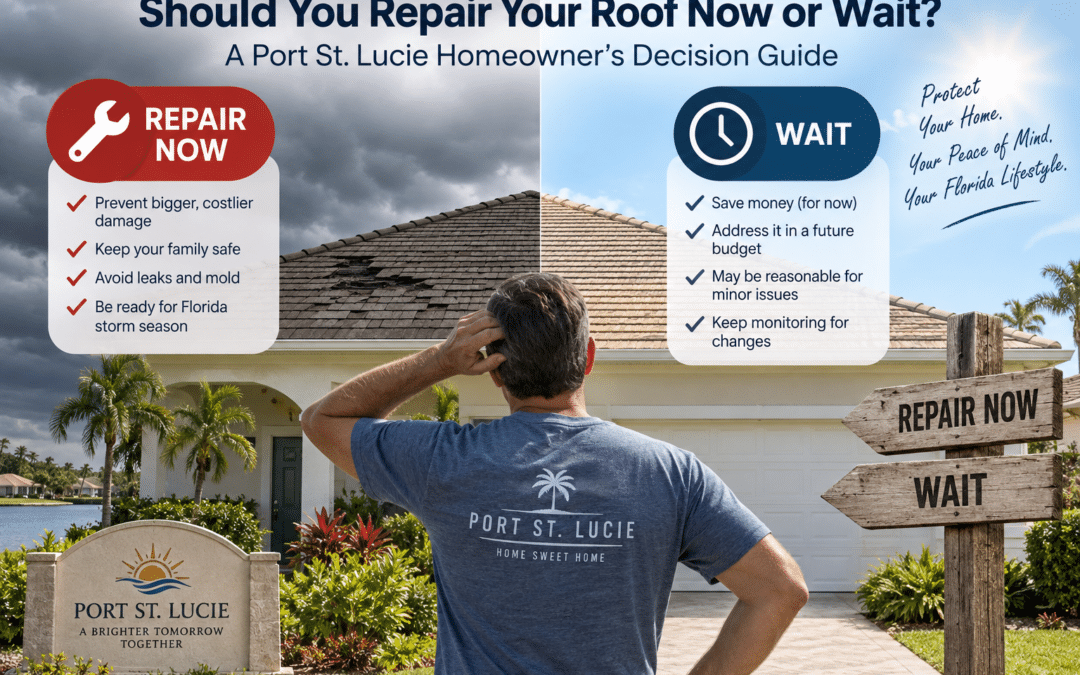
There is a particular kind of roofing problem that creates more uncertainty than an obvious emergency.
It is the problem that seems manageable.
Maybe you noticed a small ceiling stain after a heavy rain. Perhaps a few shingles look different from the rest. Maybe a roofer mentioned that the roof is beginning to show its age, but there is no active water dripping into the house.
Nothing feels catastrophic.
So you start wondering whether you should do something now or simply keep an eye on it.
For homeowners in Port St. Lucie, that decision can be more complicated than it first appears. Florida weather has a way of turning small roofing concerns into much more noticeable problems, but replacing or repairing a roof prematurely does not make sense either.
The goal is not to react out of fear.
It is to understand what you are actually waiting for.
Waiting Is a Decision Too
Homeowners sometimes treat waiting as though they have not made a decision yet.
In reality, waiting is a decision.
You are deciding that the current condition of the roof is acceptable enough to continue using it without additional work.
That can be perfectly reasonable.
If a roofing system is performing well and a professional has not identified a problem requiring attention, there may be no reason to rush into unnecessary work.
The question changes when you already know there is an issue.
If water has entered the house, roofing material is visibly damaged or the same problem has returned several times, waiting means accepting the possibility that the condition could continue or worsen.
That does not automatically make waiting wrong.
It simply means the decision should be intentional.
Start With One Question: Do You Know What the Problem Is?
Before deciding whether to repair anything, determine whether the problem has actually been diagnosed.
This distinction matters more than most homeowners realize.
Imagine you see a brown stain near the ceiling after a hard rain.
It is natural to think, “I have a roof leak.”
That may be true.
But you still do not know why the roof leaked, how water entered or whether the problem is isolated.
Water can travel through a building before becoming visible inside. The location of the ceiling stain may not be directly below the point of entry.
If you are deciding whether to repair now or wait, your first objective should be understanding the cause.
Waiting on an unknown problem is very different from waiting on a known, stable condition.
The Problem With “It Only Happened Once”
One of the most common reasons homeowners delay roof repair is that the leak happened during one unusual storm and then disappeared.
A month passes.
The ceiling dries.
Nothing else happens.
It becomes easy to believe the problem resolved itself.
But roofs generally do not repair themselves.
What may have changed is the weather.
A certain combination of rainfall intensity and wind direction may have exposed a vulnerability that lighter storms did not.
Port St. Lucie can experience powerful afternoon thunderstorms and wind-driven rain. A roof may remain dry during several ordinary showers and then leak again when similar conditions return.
The absence of another leak is encouraging.
It is not necessarily proof that the original problem no longer exists.
Consider the Difference Between Damage and Deterioration
This is another useful distinction.
Damage can be localized.
Perhaps something affected a small section of the roofing system and the rest remains in good condition.
Deterioration is broader.
It describes a roofing system that is changing over time due to age, exposure or accumulated wear.
The difference matters because localized damage may be a straightforward repair situation.
Widespread deterioration may lead to a bigger question about whether continued repairs are still the best investment.
A homeowner trying to decide whether to act now should ask not only, “What is wrong with this spot?” but also, “What condition is the rest of the roof in?”
Florida Weather Changes the Risk of Waiting
If Port St. Lucie had months of predictable dry weather, homeowners might have a larger margin for postponing certain roofing concerns.
Florida is less cooperative.
Heavy rainfall can arrive quickly, especially during wetter parts of the year. Tropical weather adds another level of uncertainty.
This does not mean every small issue requires immediate roof replacement.
It means known water-entry problems should not be treated casually.
A roofing vulnerability that produces a small stain today could allow additional moisture into the building during future weather.
The longer the issue continues, the more difficult it can become to separate the original roofing problem from secondary damage inside the home.
What Are You Hoping Will Happen If You Wait?
This is a surprisingly useful question.
Suppose you have a known roofing issue and are considering waiting six months.
What outcome are you expecting?
If the answer is, “I want to save money now and I understand the roof is still serviceable,” that is a clear decision.
If the answer is, “Maybe the problem will just go away,” that is less convincing.
Roofing decisions become easier when homeowners identify the real reason behind the delay.
Sometimes it is budget.
Sometimes they are unsure whether the repair is necessary.
Sometimes they are planning a full replacement soon and do not want to spend money twice.
Sometimes they simply do not know what to do.
Each situation should be evaluated differently.
When Waiting for a Future Roof Replacement Can Make Sense
Imagine a homeowner already plans to replace the entire roof in the near future.
A small issue appears.
Should they repair it?
Maybe.
The answer depends on the severity of the problem, the replacement timeline and whether the current roofing system can safely continue performing until that project begins.
This is where a roofing evaluation becomes especially helpful.
A contractor may determine that a localized repair is still worthwhile to protect the home in the meantime.
In another situation, the replacement may be close enough that a different approach makes more sense.
The important thing is not to assume.
A known leak should not simply be ignored because a replacement is somewhere on the future calendar.
The Cost of Repair Is Not the Only Cost to Consider
Homeowners understandably focus on the roofing invoice.
But a leaking roof can affect more than roofing material.
Once water moves beyond the exterior system, other building materials can become involved.
That does not mean every leak immediately causes extensive interior damage.
It means the total financial risk of waiting is not limited to the future cost of fixing the roof.
This is especially worth considering when the same area has leaked more than once.
At that point, the decision is no longer between spending money and spending nothing.
It may be between addressing the source now or accepting the possibility of additional work later.
But Do Not Let Fear Push You Into an Unnecessary Replacement
There is another side to this conversation.
Roofing is expensive.
Homeowners should not feel pressured into replacing an entire roof simply because one repairable problem exists.
If the issue is localized and the remaining roofing system is in suitable condition, a repair may be completely appropriate.
A trustworthy roofing discussion should leave room for that answer.
The goal is not to replace as many roofs as possible.
The goal is to choose an appropriate response to the condition of the home.
If replacement is recommended, the homeowner should understand why a repair is not the preferred option.
That explanation matters.
Repeated Repairs Change the Math
Suppose your roof has now been repaired three times.
The individual repairs may each have been reasonable.
But at some point, homeowners should stop looking at them as completely separate expenses.
Add them together.
Then ask what condition the roofing system is in today.
If the repairs have extended the useful service of an otherwise good roof, that may represent excellent value.
If each repair has simply addressed another new failure on a system that is deteriorating throughout, the economics begin to change.
A fourth repair may still be cheaper than replacement today.
The more important question is whether it is buying meaningful additional service life.
Think About Your Own Plans for the House
The right decision can also depend on how long you expect to own the property.
Someone planning to remain in a Port St. Lucie home for another twenty years may approach a deteriorating roof differently from someone with shorter-term plans.
A long-term homeowner may be more willing to move forward with replacement and choose a roofing system that aligns with future goals.
Someone else may reasonably focus on making an appropriate repair while considering other property plans.
Neither situation changes the physical condition of the roof.
But it changes how the homeowner evaluates the investment.
This Is Also Where Shingle vs. Metal Can Enter the Conversation
Sometimes a repair decision becomes the beginning of a replacement discussion.
If a contractor determines the roofing system is approaching the point where continued repair is less practical, the homeowner suddenly has new choices.
Should the next roof be shingles?
Should it be metal?
Should the homeowner stay with a familiar system or use the replacement as an opportunity to make a larger change?
These decisions are easier to make when you are not standing underneath an active leak.
That is another reason to evaluate recurring roof problems before they become emergencies.
Research is much easier when you still have time.
A Practical Example
Consider two Port St. Lucie homeowners.
The first discovers a leak around one specific roof detail. The roof is otherwise performing well. The problem can be clearly diagnosed and a durable repair is practical.
That homeowner may have very little reason to replace the entire roof.
Now consider a second homeowner.
They have repaired one leak near the front of the house, another near the back and a third around a different roof section. The roof is also showing broader signs of deterioration.
Technically, another repair might still be possible.
But the conversation should now include replacement.
The difference is not simply the number of leaks.
It is what those leaks say about the condition of the system as a whole.
The Best Time to Make the Decision
The best time is usually before urgency takes control.
When water is actively entering the house during a major storm, homeowners are naturally focused on stopping the immediate problem.
That is not the ideal moment to research roofing materials, compare contractors or think carefully about long-term value.
If you already suspect that your roof is moving toward replacement, begin gathering information now.
You do not have to commit to the project immediately.
Understand the condition.
Learn your options.
Compare shingles and metal if both interest you.
Ask contractors to explain what they are recommending and why.
Then you are making a planned roofing decision instead of an emergency one.
What Should a Port St. Lucie Homeowner Do Next?
If you have no reason to believe the roof has a problem, ordinary awareness may be enough.
If you have an active leak, recurring water stain, visible damage or repeated repair history, have the condition evaluated.
The evaluation should help answer two questions.
First, what is causing the current problem?
Second, what condition is the rest of the roofing system in?
Those answers give you a much stronger foundation for deciding whether to repair now, plan for replacement or continue monitoring the roof.